Perspiring Hands

From The American Horologist magazine, January 1942

Perspiring Hands
By L. C. McALLISTER

In your November issue "Information Please", J. J. asks, "Can you advise what to do for hands that perspire ?"


For twenty years I have had this same condition, until about a year a,go. It is a nervous condition, caused by constipation from constant bench work.


I studied a book written by Dr. Munroe of the Placid Lake, N. Y. Health Club "Man Alive You're Half Dead." A book of the month. I recommend that J. J. send two dollars for this book. He will learn more about eating habits and how to really correct his trouble, than any diet given by general practitioners. If he will do this, I know it will solve his problem.
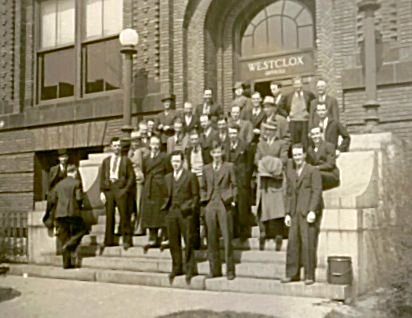

Elgin Class Visits Westclox, 1938

I was sent these two photos by a gentleman whose father is show here. These pictures show a class of the Elgin watchmakers' College visiting the Westclox "Big Ben" factory in Peru, IL, in 1938.


My Grandfather spoke of taking the same field trip in 1936.

What Is a Safety Pinion?

The amount of potential energy in the coiled mainspring of a watch, particularly a large pocketwatch, is enormous. If the spring should break, the barrel containing the spring may turn with great velocity in the opposite direction of its usual motion. This would be almost certain to damage the train of the watch in any number of ways.

Many vintage American watches include the words "Safety Pinion" or "Safety Barrel" on the movement. The safety pinion refers to a pinion on the center shaft of the watch, which engages the mainspring barrel, and which is fitted to the center shaft with course threads. These threads are usually "left handed" meaning they tighten in the opposite direction of a usual screw. By being threaded in this way, the normal force of the wound watch holds the pinion tight and this drives the watch. But if the mainspring barrel moves the other way, the pinion is unscrewed. It will thus move rapidly down the shaft and disengage from the teeth of the mainspring barrel, saving the watch from damage.

The safety pinion is an American invention patented in 1857.


The Sound of a Watch

I was thinking of writing a post here about the sound a typical watch makes; the "ticking" sound. The fact is that this is the sound of the lever escapement, which virtually all watches made after 1900 or so have (other escapements make a notably different sound, which is a whole other topic).

The ticking of a lever escapement is actually a repeating cycle of five separate impacts in the mechanism

Elgin Watch Part Numbers

I have posted a listing of Elgin part numbers, here:

http://www.rdrop.com/~jsexton/watches/partNumbers1.html

These are the "part type" numbers, not the re-order or factory numbers. For example number 3 is "Arbor, Winding" and number 198C is "Screw, Balance Bridge".

Hopefully others will find this information useful.

Hamilton 4992B Navigation Timer

Here's an interesting piece. This is a WWII era Hamilton 4992B, 16 size, 22 jewels (note the extra jewel for the seconds pivot). It is very similar to Hamilton railroad pocketwatch models, but features a center second hand and a 24 hour dial.
The hour wheel on this watch is geared such that the hour hand goes completely around once every 24 hours rather than the usual 12 hours. The watch also include a mechanism to stop the balance when the watch stem is in setting position to allow synchronization to the second.

Creating a New Balance Staff

http://watchmakingblog.com/2009/02/06/a-balance-staff/

J. Peter offers a nice run-down on creating a replacement balance staff over on his blog, watchmakingblog.com. It's worth a look - very good photography...

Blog Archive