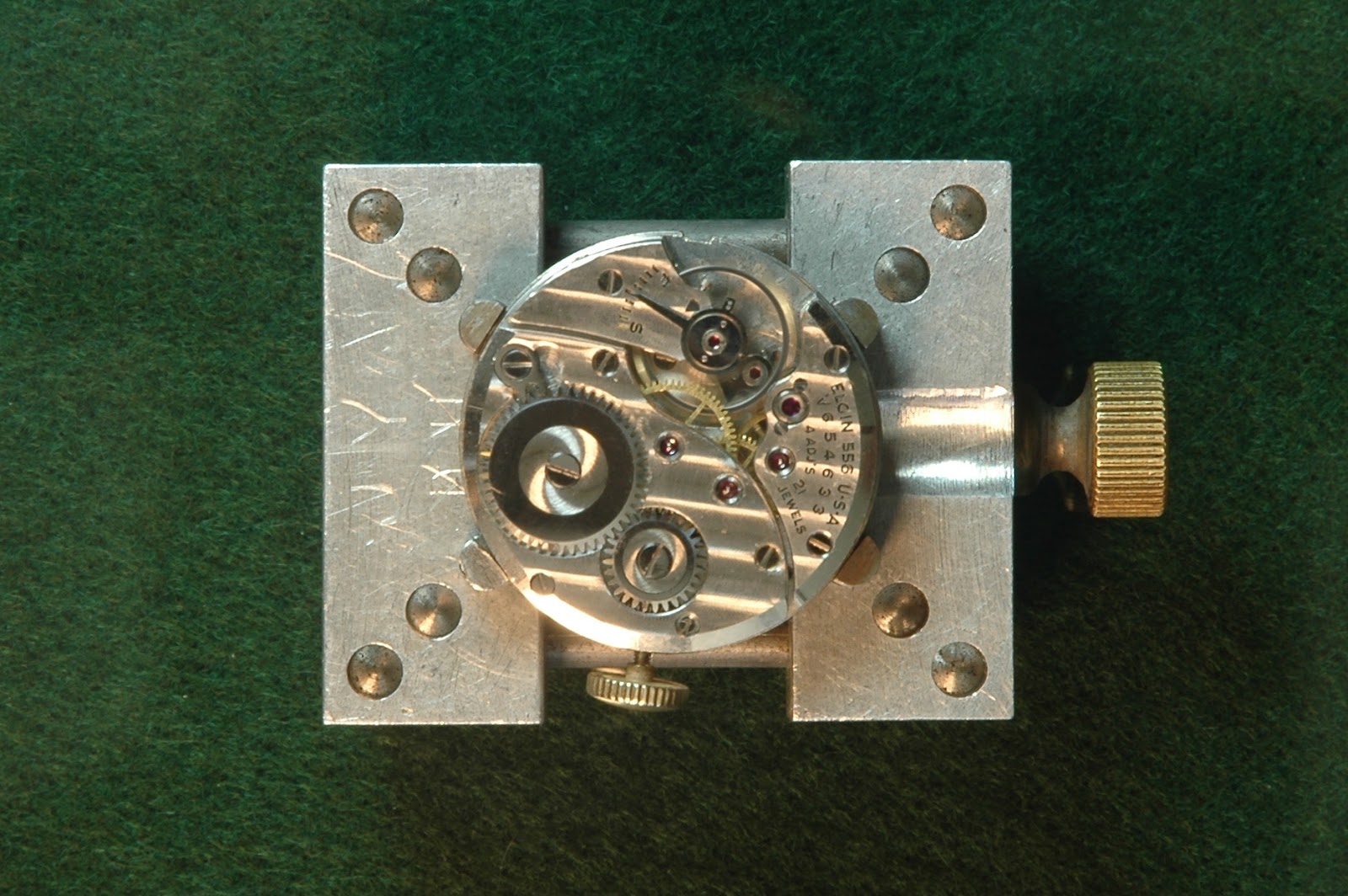
This watch had a remarkable "fix" done to the minute hand.
It's actually a grade 478 Elgin, 16 size, 21 jewels, made about 1926, B. W. Raymond model.
Elgin Grade 478
This is a grade 478 Elgin, 16 size, 21 jewels, made about 1926, B. W. Raymond model. This watch had really seen better days when I started...
An Interesting Mainspring Fix
It's always something...
This mainspring barrel has a wad of paper stuff in there. I'm assuming it was doing its best to hold the inner end of this worn out spring hooked on the mainspring arbor.
File under "creative" fixes...
This mainspring barrel has a wad of paper stuff in there. I'm assuming it was doing its best to hold the inner end of this worn out spring hooked on the mainspring arbor.
File under "creative" fixes...
What Is to Be Gained by Watchmakers' Union?
From American Horologist magazine, April, 1936
Through years of observation we have noticed many watchmakers' unions organized with all good intent of assisting the man at the bench. But can any section of the country point out any real benefits derived through this sort of cooperation? We think not, and here is the reason.
Watchmakers are not employed in great numbers. Often the highest number being employed in the larger stores will not exceed five, but how many stores use more than one? Very few! How then can such groups benefit through unions? They cannot! It has been noticed that these men are mislead believing they can secure higher wages, shorter hours. This is desirable, to be sure, but the surest way to secure better pay for your endeavor is to better your personal ability at the bench; make yourself more valuable to your employer; improve your ability to meet the public.
Many, yes the majority of watchmakers are hoping for a state legislation to protect their field of endeavor through licensing, and still many are affiliated with our organization. Have these men stopped to think of the light they place themselves in? First, they want to be protected through state licenses; to be looked upon as professional men. Second, they identify themselves with unions, and the unions, in all due respect to them, are a body of workers. Have you ever heard of a professional man belonging to a labor organization? You have not! Then why should the watchmakers be so blind as to identify themselves with such labor groups?
We would advise all watchmakers to hold fast to their high ideals and aspirations of being classed and so recognized as professional men, and secure those objectives, which will elevate the entire craft to the level of a professional status.
This is no reflection on the A. F. of L. We hold them in the highest esteem in their respective fields of endeavor, but we do contend that the watchmakers have no place in labor unions. Join your local horological association, and devote the time and money to their cause.
You will be able to go further, and attain success faster. N early every state in the union now has, some representative truly watchmakers' association functioning along the lines of the old time guilds, and after all, that is what we are all copying. The old horological guilds, where men of a common calling banded together for their mutual benefits and exchanged ideas to elevate their craft.
In joining an organization of horologists, be it in California, New York or any other state, be sure the association is one without the principal of a labor organization, thus you will be identified with an association, which wishes to uplift the craft beyond the level of labor, to one of a professional status.
What Is to Be Gained by Watchmakers' Union?
Watchmakers are not employed in great numbers. Often the highest number being employed in the larger stores will not exceed five, but how many stores use more than one? Very few! How then can such groups benefit through unions? They cannot! It has been noticed that these men are mislead believing they can secure higher wages, shorter hours. This is desirable, to be sure, but the surest way to secure better pay for your endeavor is to better your personal ability at the bench; make yourself more valuable to your employer; improve your ability to meet the public.
Many, yes the majority of watchmakers are hoping for a state legislation to protect their field of endeavor through licensing, and still many are affiliated with our organization. Have these men stopped to think of the light they place themselves in? First, they want to be protected through state licenses; to be looked upon as professional men. Second, they identify themselves with unions, and the unions, in all due respect to them, are a body of workers. Have you ever heard of a professional man belonging to a labor organization? You have not! Then why should the watchmakers be so blind as to identify themselves with such labor groups?
We would advise all watchmakers to hold fast to their high ideals and aspirations of being classed and so recognized as professional men, and secure those objectives, which will elevate the entire craft to the level of a professional status.
This is no reflection on the A. F. of L. We hold them in the highest esteem in their respective fields of endeavor, but we do contend that the watchmakers have no place in labor unions. Join your local horological association, and devote the time and money to their cause.
You will be able to go further, and attain success faster. N early every state in the union now has, some representative truly watchmakers' association functioning along the lines of the old time guilds, and after all, that is what we are all copying. The old horological guilds, where men of a common calling banded together for their mutual benefits and exchanged ideas to elevate their craft.
In joining an organization of horologists, be it in California, New York or any other state, be sure the association is one without the principal of a labor organization, thus you will be identified with an association, which wishes to uplift the craft beyond the level of labor, to one of a professional status.
Do You Know?
From The American Horologist magazine, April, 1936
Do You Know?
Directed by
W. H. Samelius, Chairman
Science of Horology and Technical Board
Directed by
W. H. Samelius, Chairman
Science of Horology and Technical Board
The first really portable watch or clock was made by Peter Henlein, a young blacksmith, of Nuremberg about 1504. It was made entirely of iron, spring driven, the dial of the watch was about six inches. Timepieces were usually carried by shoulderstrap or handle.
The Waterbury Watch Company in the early days used the Duplex Escapement in their watches.
That the mainspring in the early Waterbury watches were nine feet long.
The Hamilton Watch Company was founded in Lancaster, Pa., in 1892.
Our first wheel-cutting machine was invented by Dr. Robert Hooke of England.
Second hands on clocks were first used by Tompion of England about 1676.
The Greenwich Observatory at England was founded in 1675 for promotion of astronomy and navigation.
That the overcoil hairspring was introduced by Abraham Louis Breguet about 1775.
That adjusting a pocket watch for temperature errors, the corrections are made by relocating the· balance screws closer or farther away from the cut end of the balance wheel rim.
In the marine chronometer adjustments for temperature errors are made by sliding a weight which is attached to the rim of the balance wheel.
In some of the finest cylinder escapements, the cylinder was made of ruby.
The cylinder and duplex escapements are known as frictional escapements.
The lever escapement is known as the detached escapement.
In 1898 Radium was discovered by Mme. Curie of France, a pitch blend derivative is used in making the hands and dials of watches luminous in the dark.
All time is calculated East or West of the meridian at Greenwich, England.
The first enamel watch dials were produced in 1635 by Paul Viet of Blois, France.
The first public clock in Spain was set up in the Cathedral of Seville, about 1400 A.D.
The anchor escapement was invented by Dr. Hooke of England, about 1670, the pallets were designed so as to greatly reduce recoil of the escape wheel.
The large clock movement, or Big Ben in the Tower of Westminster, London, was designed by Lord Grimthrope of London, England. It is controlled by means of a gravity escapement, also of his designing. Webster's definition of Horology-the science of measuring time, or the principles and art of constructing instruments for measuring and indicating portions of time, as clocks, watches, dials, etc.
Long before the Christian era, clepsydra or water clocks were in use, but the name and inventor of these instruments have not been reliably recorded. It is said Censor Scipio Nasica was the first to measure the hour by water, by night as well as by day, in the year of 595 B.C.
Some Bow Tools
Here's a little engine for altering and fitting the end of pocketwatch case bows, and also a pair of pliers used in installing the bows. These pliers close the close, there is another type the pulls it open.
Elgin Grade 291, Loose Case Screw
This is a grade 291 Elgin. It's a 16 size, 7 jewel movement, this one with a masonic dial, which I do not believe to be real old. The dial design seems to be a printed piece of paper somehow adhered to a normal dial.
This watch stopped because of a loose case screw stuck in the movement.
Elgin Grade 301
Here's an Elgin grade 301, 12 size, 7 jewels, made about 1919. It;s in a 20 year gold filled open-faced case, unusual 10-sided edge.
Digital Calipers
When I was going up, my father owned a really nice calipers with an analogue dial. I was fascinated by this tool and spent a lot of time measuring cat hairs, how thick paper was and other such things.
There are remarkably inexpensive versions of this tool today. And as far as I can tell they work just fine.
Train Counting
First, some terminology...
The train of a watch is made up of
wheels and pinions, each on an axis, or staff. The pinion the the
small part on the inside, and the wheel generally is the large part.
Wheels have teeth. Pinions have leaves. The train starts with the mainspring barrel, then the center wheel (or great wheel), then the third wheel, the fourth wheel, and finally the escape wheel. In this image, the center wheel is the large wheel at the left. The train goes clockwise up and to the right from there, in the picture.
Looking at this next view, we see the mainspring barrel at the left, the center wheel in the center, and so on, pinion to wheel, to pinion, to wheel, etc.
The third wheel is a bit tucked away and hard to see in this photo.
As an aside, this watch has a "motor barrel."
Next, this is a different movement, with a different layout. The design is the same.
This watch has a "going barrel."
Counting the Train
Here's a commonly used equation to get
started.
n1 is the number of revolutions of the
center wheel per hour. This is almost always one, this is the minute
hand.
n4 is the number of revolutions of the
4th wheel per hour. This is almost always 60, this is the seconds
hand.
z1 is the number of teeth on the center
wheel.
z2 is the number of leaves on the third
wheel pinion.
z3 is the number of teeth on the third
wheel.
z4 is the number of leaves on the
fourth wheel pinion.
n4 z1 * z3
-- =
---------
n1 z2 * z4
This equation gets to a watch that
reads correctly, that is the minute and hour hands are in sync with
the seconds hand. For this we don't care about the number of teeth on the barrel, nor the number of leaves on the center pinion. This is because time reading begins at the center wheel; it is the minute hand.
Considering the rate take a little more work.
"Fast-beat" vintage American
watches beat at 18,000 beats per hour, or 2.5 Hz. One way to observe
this is the fact that for each second, the second hand jumps five
times.
z6 *
18000
-------------
= 1
z5 * ze
* 2
z5 is the number of teeth on the forth
wheel.
z6 is the number of leaves on the
escape wheel pinion.
xe if the number of "teeth"
on the escape wheel.
This equals one because one is the
number of revolutions per hour of the center wheel (n1 above).
Because of the action of the pallet stones the number of foot-shaped
teeth on the escape is multiplied by two.
There's another way to look at this, by
fixing the number of revolutions per hour of the 4th wheel (the
seconds hand) to 60.
60 * z2
* z4
--------------
= 1
z1 *
z3
And there you have it. Pinion
leaves are on the top, wheel teeth are on the bottom.
Why worry about this? Simple, every now and then an obscure watch will be missing a part. Using the above, and some algebra, it is possible to figure out what the part should be like. Sometimes, if the balance is missing, we won't know what the beat rate should be. If the train is there it can be calculated.
A Mishandled Mainspring
This is the result of an incorrectly installed pocketwatch mainspring. The spring is very badly out of flat. It's not broken, so it's a shame. There's no way to fix it. This spring is unusable due to the friction and wear it would could inside the barrel.
Grinding a Cannon Pinion
Here we see the cannon pinion on an early Elgin 18 size pocketwatch.
These cannon pinions are solid body parts and so can't be tightened by the usual means. A few times, I have seen this sort of thing. A watchmaker has ground down a notch in the side of the part so it would be thin enough to squeeze down some.
Not exactly a recommended solution...
These cannon pinions are solid body parts and so can't be tightened by the usual means. A few times, I have seen this sort of thing. A watchmaker has ground down a notch in the side of the part so it would be thin enough to squeeze down some.
Not exactly a recommended solution...
Elgin Grade 495
This is a grade 495 Elgin. It's a 12 size movement, 17 jewels, this one made about 1933. It has a 10k gold-filled, open-faced case, snap-on front and back.
Tracey Appleton Waltham
This is an 18 size Waltham, Tracey Appleton model, gold flashed, 15 jewels, 1883, stem-wind and stem-set, in a Silverine open face case. Note the 24 hour, double-sunk dial.
Great watch!
Great watch!
Subscribe to:
Posts (Atom)
Blog Archive
-
▼
2013
(281)
-
▼
April
(30)
- Creative Hand Fix
- Elgin Grade 478
- An Interesting Mainspring Fix
- Westclox Pocket Ben
- What Is to Be Gained by Watchmakers' Union?
- Elgin Grade 556, Lord Elgin
- Do You Know?
- Some Bow Tools
- Elgin Grade 291, Loose Case Screw
- Elgin Grade 301
- Elgin Grade 660
- Digital Calipers
- Train Counting
- Elgin Grade 444
- A Mishandled Mainspring
- Grinding a Cannon Pinion
- Elgin Grade 495
- Tracey Appleton Waltham
- 1910 Hampden
- Rockford
- 1880 Illinois
- DIY
- Hand Tool
- Keeping the Cap On
- "Perpetual Motion" Clock Run by Changes of Tempera...
- Finding the Correct Length for Mainsprings
- Consider the Benefits
- Creative Dial Attachment
- A Later Elgin
- Illinois Autocrate
-
▼
April
(30)